More than half of companion animal practices in our 2026 survey reported revenue growth in 2025. That sounds like good news. But it might not be as promising at it appears.
Veterinary service prices rose 6 to 7% industrywide last year, while patient visits declined for the third consecutive year. If your revenue went up 5%, you didn't grow. You raised your prices and saw fewer patients. Those are two very different things.
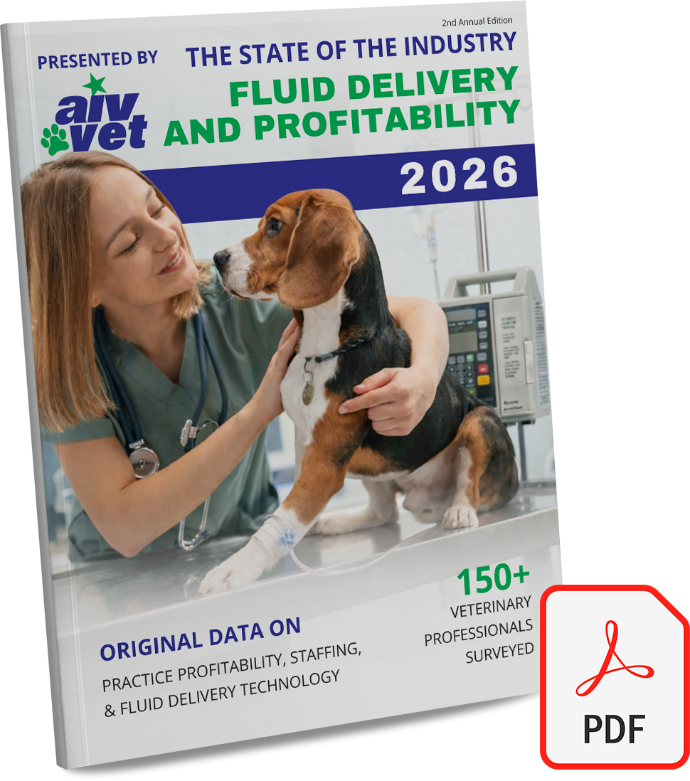
This blog covers one section of our 2026 Veterinary IV Pump Survey. The full report includes data on equipment spending, staffing costs, fluid therapy trends, and business sustainability across 114 companion animal practices.
Gross revenue vs. real revenue
Gross revenue is a starting point, not a verdict. To understand whether your practice is actually growing, you need two adjustments.
- Strip out inflation. AVMA data shows the average U.S. veterinary practice generated $1.5 million in gross revenue in 2024. Adjusted for inflation, that number has barely moved since 2016. Eight years of nominal growth, and in real terms, roughly flat.
- Divide by your veterinarians. Revenue per FTE veterinarian has declined from approximately $600,000 in 2019 to $555,000 in 2024. According to the data, most teams aren’t generating more revenue per person. They're generating less and that gap is widening.
When you run both calculations, the story changes for most practices.
Where practices actually stand
Here's how the revenue picture breaks down from our 2026 survey of 114+ companion animal practices.
Revenue change in 2025 | % of practices |
Increased more than 20% | 4% |
Increased 11-20% | 14% |
Increased 0-10% | 38% |
Flat (within 2%) | 20% |
Decreased 0-10% | 16% |
Decreased more than 10% | 8% |
The 20% who came in flat aren't holding steady. With inflation running at or above that range, flat revenue is a real-dollar decline.
And the 24% reporting outright revenue decreases are in the hardest position of all. They raised prices along with everyone else and still lost ground. That means volume dropped enough to overwhelm the fee increases.
The 4% growing more than 20% are almost certainly winning on patient volume, not just pricing power. That's a fundamentally different practice.
Fewer patients every year

Image courtesy of Envato
There's a structural issue underneath the revenue numbers. According to AVMA data, the average veterinary practice has been losing roughly 95 active clients per year since 2019, reaching 3,351 active clients per practice in 2024.
It's a multi-year pattern and raising prices can only carry a practice so far. At some point, shrinking patient volume means shrinking real revenue, regardless of what's on the fee schedule.
What this means for equipment decisions
If your practice grew nominally but is flat or negative once you adjust for inflation, that describes most practices, and every capital expenditure needs to clear a higher bar than it did five years ago.
Buying a new veterinary infusion pump at full manufacturer cost might sometimes make sense when revenue is genuinely growing. When real revenue per veterinarian is declining, it’s almost certainly not the right move. The question isn't just whether you can afford it, but whether it delivers a return you can measure.
Refurbished IV pumps from AIV Vet run 30 to 50% below new cost, carry a 1-year warranty, and go through a 27-point inspection and calibration process. For a practice with 3 to 4 pumps in rotation, the savings on a single equipment refresh can run $3,000 to $8,000 depending on model and quantity.
It's a rational response to where the revenue data actually points.
Want the full data? Download the 2026 AIV Vet Industry Survey for complete findings on practice revenue, staffing, and equipment strategies across 114+ veterinary practices.
Sources: AIV Vet 2026 Companion Animal Survey; AVMA 2025 Economic State of the Veterinary Profession; AVMA 2025 Veterinary Business and Economic Forum presentation by AVMA Economist Frederic B. Ouedraogo.