Most veterinary practices treat pump calibration like a dental cleaning. You know you should do it. You keep meaning to do it. And then a year goes by and you still haven't done it.
Calibration feels like one of those invisible maintenance tasks that doesn't seem urgent until something goes wrong. The pump turns on, the fluids flow, the patient gets treated. Why mess with what's working?
But. Your pump might not be working as well as you think it is. And the gap between what you're programming and what's actually being delivered widens every month you skip calibration.
What calibration drift actually looks like
CRI are supposed to deliver fluids and medications within tight accuracy windows. Most manufacturers specify ±5% accuracy for standard flow rates. Syringe pumps like the Medfusion 3500 are even tighter at ±2%.
When pumps go uncalibrated, that accuracy degrades through predictable mechanisms.
Battery capacity declines over time. Research shows that batteries at 25% capacity can cause 10-30% flow rate reduction.
Sensors drift. Pressure sensors, air-in-line detectors, and occlusion sensors all need periodic verification to stay accurate.
Mechanical components wear. Peristaltic rollers compress tubing thousands of times. Syringe pump drive mechanisms develop play. Nothing stays perfectly calibrated forever.
Environmental factors compound the problem. Temperature fluctuations and humidity cause ongoing drift - particularly at low flow rates below 10 mL/hr.
That last point matters a lot in veterinary medicine. Low flow rates are exactly what you're using for small patients. A 4-pound Chihuahua getting a CRI during surgery is operating in the accuracy range where drift has the biggest impact.
The money you're losing without realizing it
When your pump is delivering 8% more medication than programmed, you're creating a financial challenge ontop of a clinical one.
Image courtesy of Envato
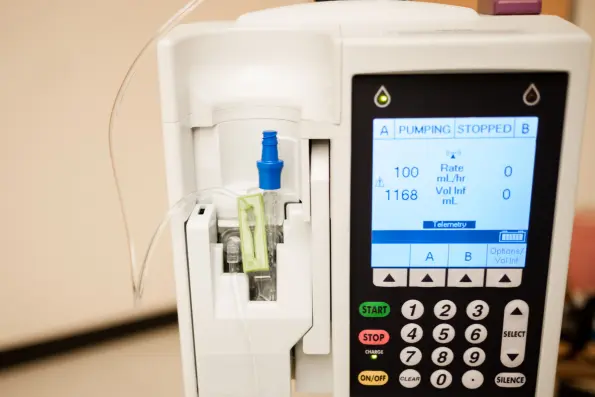
Image courtesy of Envato
Drug waste adds up fast.
If your pump consistently over-delivers by even a small percentage, you're burning through expensive medications faster than you should be. Chemotherapy drugs - increasingly common in veterinary oncology - show documented waste rates of 6-35% industry-wide. Some of that comes from vial sizes. Some comes from pumps that aren't delivering what they're supposed to.
Equipment fails at the worst possible moments.
Pumps that don't get regular maintenance don't just drift out of calibration. They fail entirely. And they tend to fail during procedures, not sitting on a shelf. Our 2025 survey found that 97% of veterinary professionals experience recurring issues with their current infusion pumps. Many of those issues trace back to deferred maintenance.
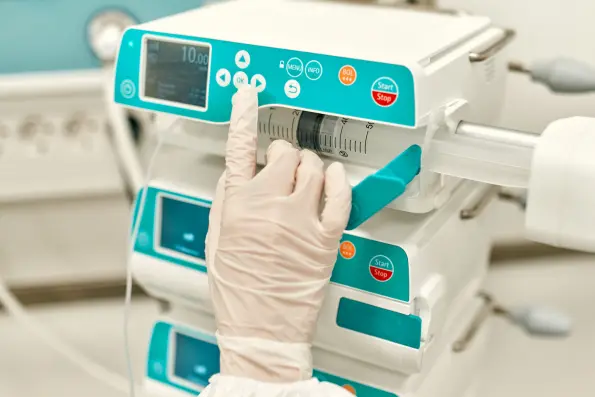
Image courtesy of Envato
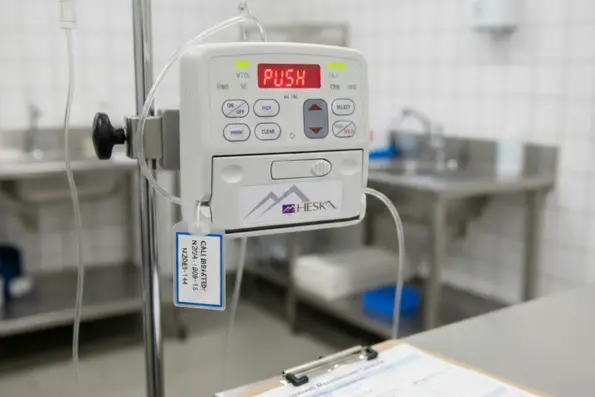
Image courtesy of Envato
Procedure times stretch.
When flow rates are off, treatment durations change. A fluid bolus that should take 30 minutes takes 35. Over a day of procedures, that's real time your team loses. Over a month, it's hours.
Liability exposure grows.
If something goes wrong with a patient and your pump hasn't been calibrated in two years, that's a question someone will eventually ask. Documentation of regular maintenance isn't just good practice. It's protection.
What the manufacturers actually recommend
Here's what the manufacturers say about calibration intervals for the pumps we commonly see in veterinary practices.
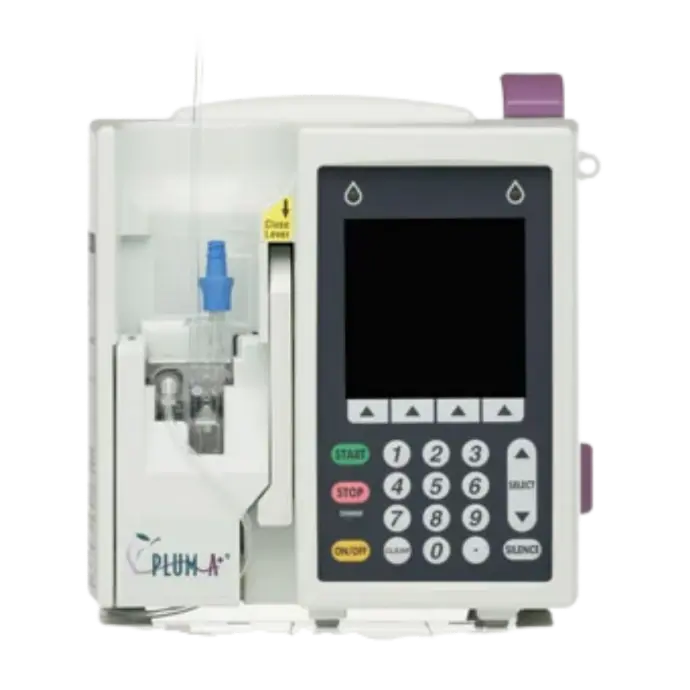
Hospira Plum A+
Annual preventive maintenance at minimum. Key parameters include pressure sensor verification, air-in-line detection, occlusion sensors, and flow rate accuracy testing.
Get my Hospira pump calibrated
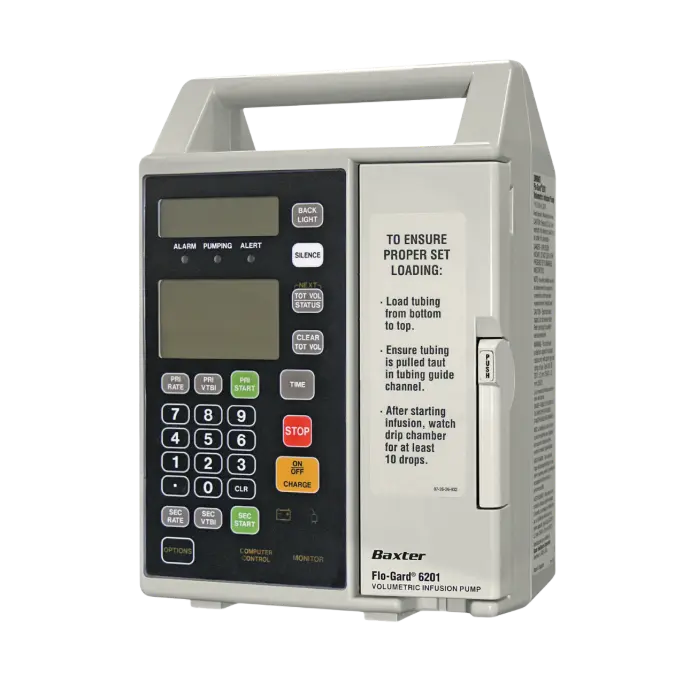
Baxter Flo-Gard 6201
Battery check every 6 months, full preventive maintenance every 12 months. The service manual specifies calibration for DC line voltage, air sensors, upstream and downstream occlusion sensors, and A/D converter reference voltage
Get my Baxter Flo Gard pump calibrated
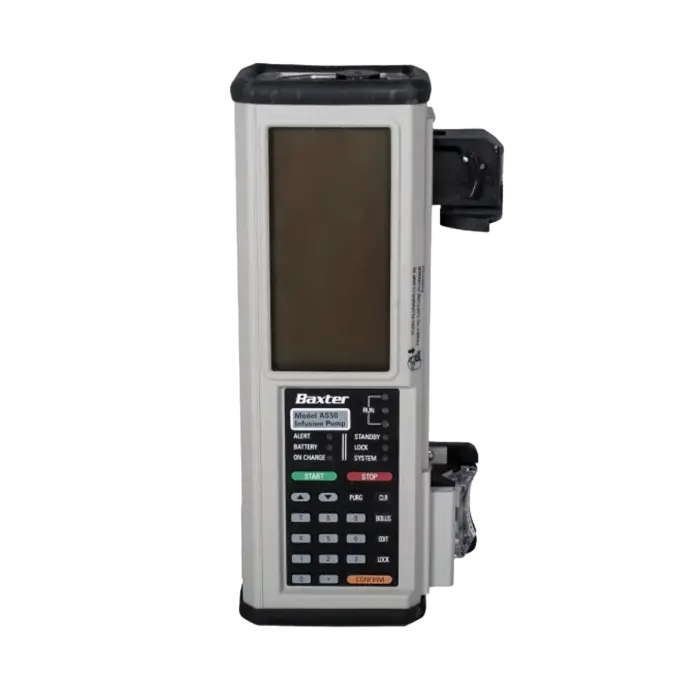
Baxter AS50
Annual calibration with battery replacement every 16 months. Important note here - Baxter has discontinued manufacturer service for the AS50. If you're still using these pumps, you need a third-party service provider for calibration. We can help with that.
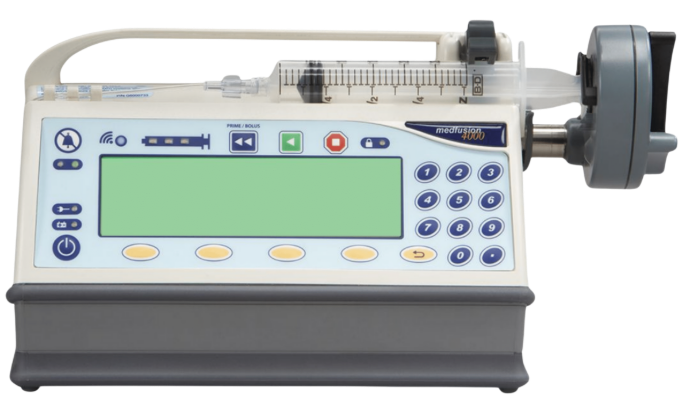
Medfusion 3500
Annual preventive maintenance. This pump has a built-in biomed menu that tracks PM dates and provides diagnostics. Calibration requires specific equipment including calibration slugs and force gauges.
Get my Medfusion pump calibrated
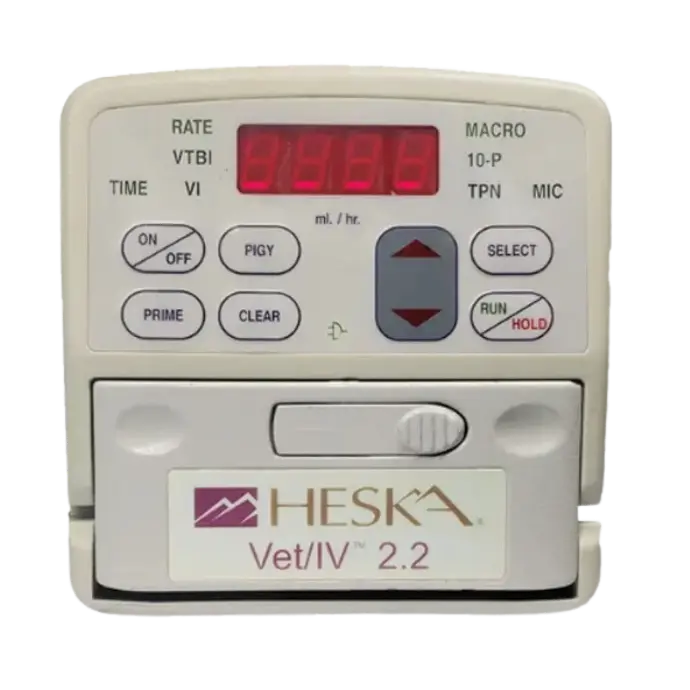
Heska Vet/IV 2.2
Annual preventative maintenance and battery check every 6 months. All other recommendations are the same as the Hospita Plum A+.
Pump model | Calibration interval | Accuracy spec | Notes |
Hospira Plum A+ | 12 months | ±5% | Active manufacturer support |
Baxter 6201 | 6 months (battery), 12 months (full) | ±5% | Legacy product |
Baxter AS50 | 12 months | ±3% | Manufacturer service discontinued |
Medfusion 3500 | 12 months | ±2% | Built-in PM tracking |
For high-risk applications - oncology drugs, anesthesia CRIs, vasopressors - consider 6-month calibration intervals instead of annual. The tighter the therapeutic window, the more calibration matters.
Why this hits veterinary patients harder
Human hospitals deal with calibration drift too. But veterinary patients face amplified risks for three reasons.
Smaller circulatory volumes.
A 10% dosing error in a 150-pound human is one thing. The same percentage error in a 6-pound cat is a much bigger deal relative to total blood volume.
Faster metabolic rates.
Small animals process drugs quickly. They respond to dosing changes faster than humans do. Less margin for error means less time to catch problems.
Narrow therapeutic windows.
Many veterinary medications - particularly anesthetics and analgesics - have tight ranges between effective and toxic doses. Pump inaccuracy shrinks that window further.
At flow rates below 1 mL/hr, common in small animal anesthesia, start-up delays can exceed 60-75 minutes before the pump achieves target delivery. If your pump is also drifting 10% high or low on top of that, you're operating with significant uncertainty about what's actually reaching the patient.
What to do about it
Check when your pumps were last calibrated. If you don't know, that's a sign. If it's been more than 12 months, schedule service.
Create a maintenance calendar. Put calibration dates on whatever system you use to track recurring tasks. Treat it like equipment that expires - because functionally, uncalibrated pumps have.
Document everything. Keep records of calibration dates, who performed the service, test results, and next due dates. This matters for AAHA accreditation if you have it, and for liability protection either way.
Standardize your consumables. Using the wrong syringes or tubing can add 10-20% error on top of whatever calibration drift exists. Stick with manufacturer-specified supplies.
Build a relationship with a service provider before you need one. Especially if you're running discontinued equipment like the Baxter AS50. When a pump fails at 7 AM on a surgery day, you don't want to be searching for someone to fix it.
The math is simple
The cost of a pump that drifts out of spec - in wasted drugs, extended procedures, emergency repairs, and potential liability - is dramatically higher than the cost of your annual calibration.
Every dollar spent on preventive maintenance saves roughly five dollars in downstream costs. That's not a platitude. It’s documented across healthcare settings.
Your pumps are working every day. They deserve maintenance that keeps them working accurately. And your patients deserve the precision those pumps are supposed to provide.
Need help getting your pumps back on schedule?
We offer calibration and repair services for the Hospira Plum A+, Baxter 6201, Baxter AS50, Medfusion 3500, and other infusion equipment commonly used in veterinary practices. Get in touch with our team to set up a maintenance plan that fits your practice.
Sources
NCBI | The urgent need for innovation in I.V. smart pumps
Baxter | Baxter Flo-Gard 6201 Service Manual
AIV-Vet | 2025 Veterinary IV Pump Survey