Watch a seasoned NICU nurse glance at a screaming monitor and calmly return to what they were doing. They've learned which beeps demand immediate attention and which ones are just noise.
Most vet techs haven't had that training. So when a CRI pump starts alarming, the response is often panic - or ignoring it entirely because they're not sure what it means.
Here's a quick reference your team can use to understand pump alarms, which ones need immediate action, and which ones might signal an equipment issue rather than a patient crisis.
Two categories of pump signals
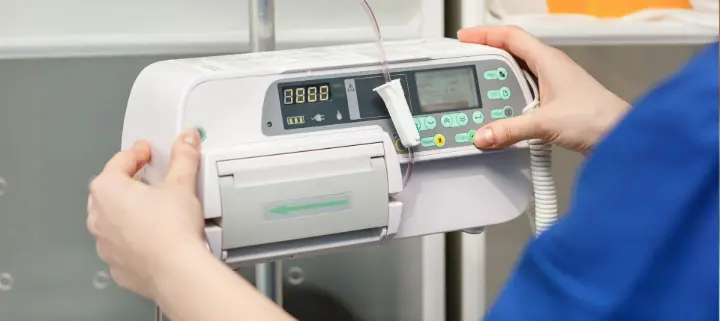
Image courtesy of Envato
Mechanical alarms
…indicate something is wrong with the infusion process - occlusion, air-in-line, low battery, door open. These happen frequently and most resolve quickly.
Clinical alerts
…indicate a programmed dose exceeds a safety threshold. Less common in veterinary settings unless you're using smart pumps with drug libraries.
Mechanical alarms are what most vet techs encounter. They're also the ones that cause the most confusion.
The alarms you'll see most often
Occlusion alarms
What it means | Something is blocking fluid flow. |
Common causes | Kinked tubing, catheter positioned in a flexion area, catheter against vessel wall or partially dislodged, clamp still engaged. |
When to question it | If you check everything and find no obstruction - tubing is straight, catheter flushes easily, no clamps engaged - the pump's pressure sensor may be overly sensitive or malfunctioning. This is common with older pumps. |
What to do | Check the tubing path for kinks. Verify catheter patency. If no cause is found and the alarm keeps triggering, try a different pump. |
Air-in-line alarms
What it means | The pump detected air bubbles in the line. |
Common causes | Air introduced when changing bags, drip chamber not properly filled, cold fluids outgassing as they warm, loose connections. |
When to question it | If the alarm triggers repeatedly despite proper priming and no visible air, the sensor might be malfunctioning. |
What to do | Stop the infusion. Locate and remove the air bubble by repriming or tapping the tubing. Ensure drip chamber is at least half full. Resume. |
End-of-infusion and KVO alarms
What it means | The programmed volume is complete or nearly complete. |
This is an expected alarm | The pump is doing its job. Reduce frequency by having the next bag ready before the alarm triggers. |
Low battery alarms
What it means | Power is running low or disconnected. |
Take this seriously | If the battery depletes, the infusion stops and settings may be lost. If a plugged-in pump shows low battery, the battery likely needs service. |
Signs the problem is the pump, not your patient
Recurring alarms with no identifiable cause.
You check everything, clear the alarm, and it immediately triggers again. One survey respondent described pumps that "get stuck in a loop of random sensor alarms" requiring constant resets.
Alarms that don't match the clinical picture.
Occlusion alarm when fluids are clearly flowing. Air-in-line alarm with no visible bubbles.
Pattern across time.
In our 2025 survey, 97% of veterinarians reported recurring issues with their current pumps - sensor alarms, battery errors, interface freezes. If the same pump causes repeated problems, it needs service.
Build a simple alarm protocol
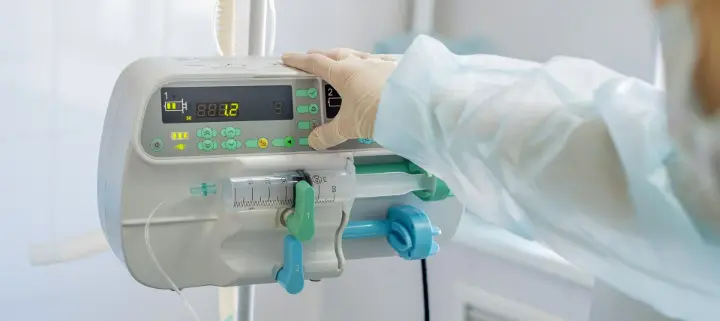
Image courtesy of Envato
Acknowledge and assess.
Don't silence and walk away. Check the alarm type and glance at the patient.
Investigate
Follow troubleshooting steps for that specific alarm.
Document
Log alarms by pump. After a month, you'll know which units are problematic.
Escalate when needed
Repeated unexplained alarms mean the pump needs service, not more troubleshooting.
Key points for training your team
An alarm is information, not an emergency. Read the display before reacting.
The pump can be wrong. Equipment fails. Sensors degrade. Healthy skepticism is appropriate.
Pattern recognition matters. The same alarm happening multiple times during one infusion likely indicates an unresolved problem - possibly with the equipment itself.
Sources:
FDA | Examples of Reported Infusion Pump Problems
AACN | Beep, Beep, Repeat: The Trouble With Intravenous Pump Alarms
AIV-Vet | 2025 Veterinary IV Pump Survey